Hello to start the new forum, I wanted to offer a few of my favorite technical enquires!
Notes on mechanical testing
So, if we have a sample rate of 150kHz, Nyquist tell us 150kHz/2 = 75kHz would be the bandwidth limit on the signal we can measure.
The above statement is true when considering frequency domain, however as sheer testing can result in events that tend to look like square waves (lots of pressure to zero pressure), we also like to consider the time domain.
I have modelled a simple filter response for an event that occurs in 1uS (or instantaneous for these purposes), square waves are made of infinite sine waves and filtering removes the sine content above a particular frequency, hence the wave shape becomes more sinusoidal in nature.
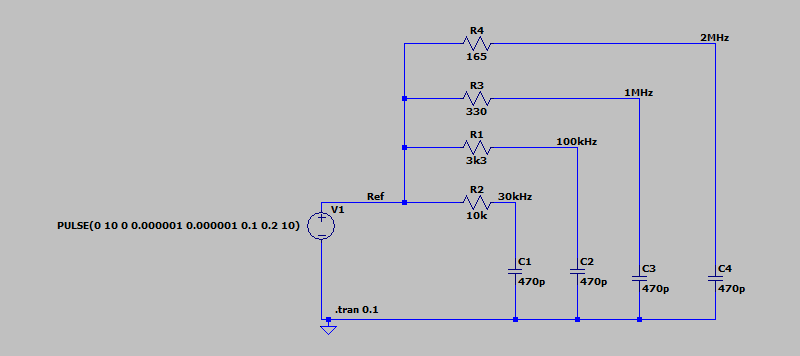

We know the data acquisition system as 150kHz sampling rate, so this is a measurement every 6.66uS. Taking the data into excel we can see how these samples will present to a DAQ.
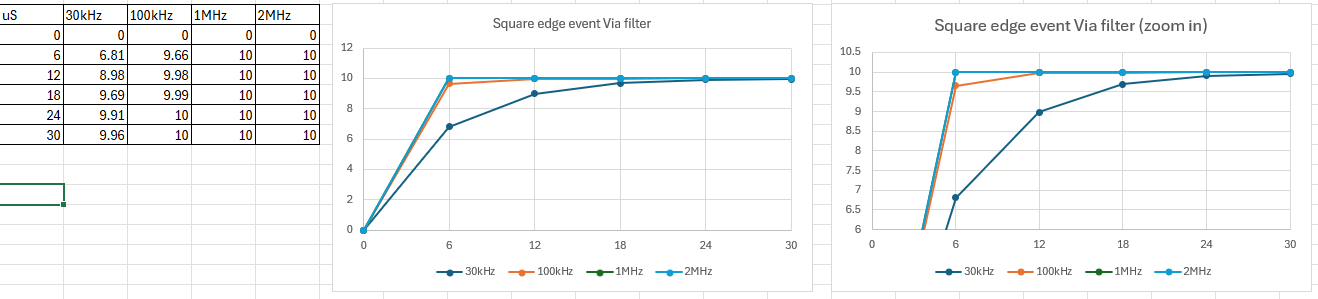
You can see that the 100kHz filter is not settled by the time the first, second or third samples after the event are taken.
We have found lots of customers performing mechanical test such as hopkinson split bar experiments are using FE-389-TA for this reason, the 1MHz bandwidth allows a greater rate of change on the measurement signal, so that time of impact (or sheer) can be extrapolated directly from the DAQ results.
We have an application note we did for a customer measuring light response and again the FE-389-TA yielded the most conclusive set of data, when they compared electrical and photo measurements.
Regards
Paul Sanders, BEng(Hons) DMS MInstP
Senior Design Engineer
 .
.